Our recent blog on the Central Coast bulk wine market generated one of the most widely read — and most controversial — responses we have published in quite some time.
Frankly, that is not surprising.
When you start putting hard numbers around Paso Robles vineyard supply, demand, and wine production, people pay attention. They should. These numbers shape how growers think, how wineries plan, and how buyers, sellers, and investors understand the long-term strength of this region.
One of the biggest points of debate was the idea that less than 25% of Paso Robles vineyard acreage is needed to support Paso Robles-labeled wines.
After more discussion and a closer look at the assumptions behind that conclusion, we believe that number is too low — likely materially too low.
And from our perspective at VPRE, that matters, because it changes the way people interpret the real depth of demand for Paso Robles fruit.
Paso Robles Is a Major Agricultural Region — Not a Niche Appellation
Paso Robles is not just a wine brand. It is one of California’s most important agricultural regions.
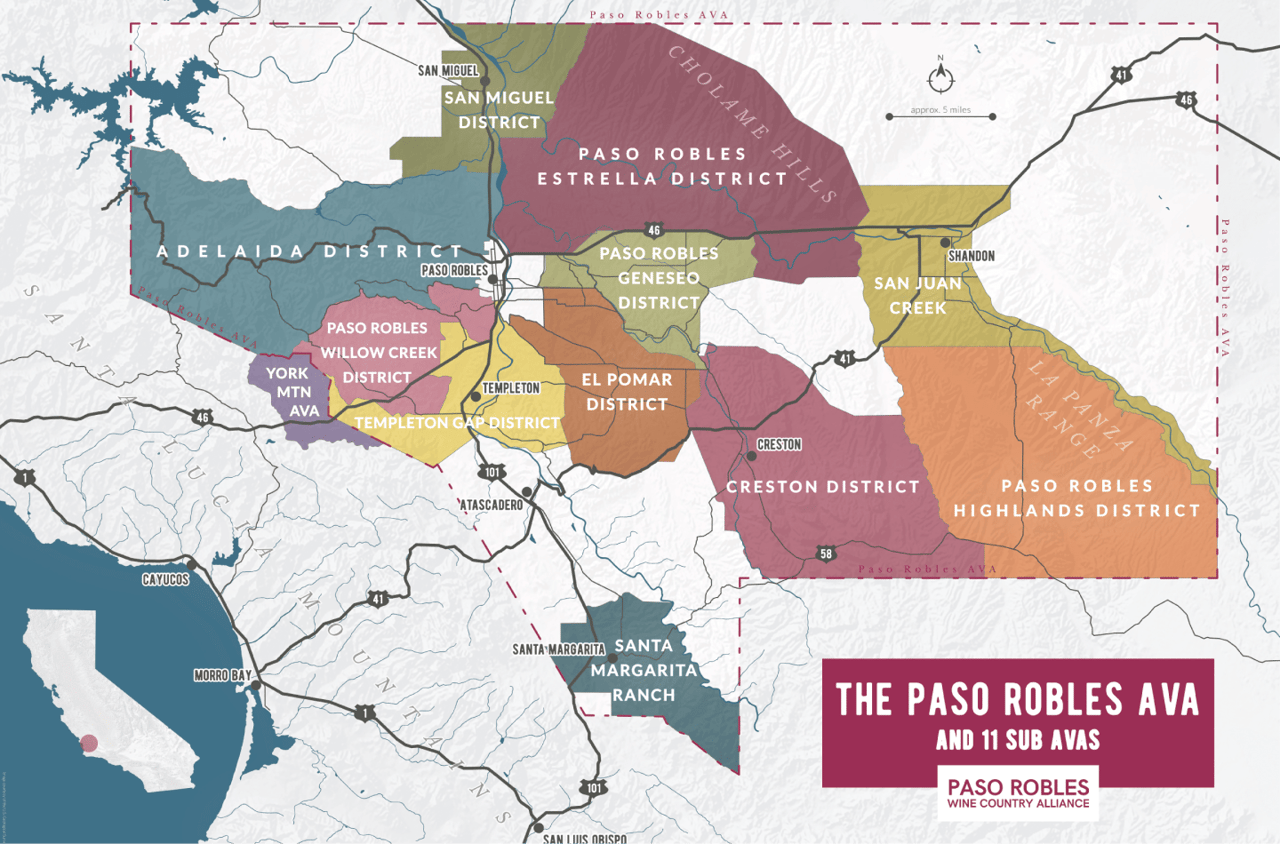
As the region approaches 150 years of commercial grapegrowing and winemaking, winegrapes remain the dominant crop here. More than 70% of agricultural acreage in San Luis Obispo County is planted to winegrapes, and in the Paso Robles Basin that figure is more than 85% of agricultural acreage.
That scale matters.
So when a conclusion suggests that fewer than one-quarter of the region’s roughly 42,000 acres of winegrapes are really needed to support Paso Robles wines, it deserves a closer look. Because that kind of statement can create the wrong impression — that most Paso Robles fruit is somehow outside the core market, disconnected from Paso Robles wine programs, or only marginally relevant to regional demand.
That is not how we see it on the ground.
The 3.5 Million Case Number Is Useful — But It Is Not the Whole Picture
A lot of this debate starts with the commonly cited 3.5 million case figure for Paso Robles-labeled wine.
The issue is not that the number has no value. It does. The issue is that it is often treated as if it represents the full universe of Paso Robles AVA wine production, when it does not.
That figure is based on Paso Robles Wine Country Alliance member data. It does not include non-members. That means it excludes a meaningful portion of the market by definition, including wineries outside that membership base that are still producing wine from Paso Robles fruit.
So while 3.5 million cases is a helpful starting point, it is not a full count of all Paso Robles-labeled wine.
And if the starting production number is understated, then any acreage estimate built from it is likely understated too.
Not All Paso Robles Fruit Shows Up Under a Paso Robles AVA Label
This is where the conversation often becomes too narrow.
A significant amount of Paso Robles-grown fruit goes into wines labeled:
-
Paso Robles
-
Central Coast
-
San Luis Obispo County
-
California
That does not mean the fruit is any less important to the market. Quite the opposite.
Paso Robles fruit is often a major contributor to quality, structure, consistency, and value in those wines. The label may be broader for blending flexibility, marketing strategy, or production scale, but the vineyard demand is still real.
So if the real question is, how much Paso Robles vineyard acreage is supported by demand for Paso Robles fruit, then looking only at Paso Robles AVA-labeled bottles does not tell the whole story.
From a vineyard market perspective, that is the key distinction.
The Yield Assumption Is Doing Too Much Work
The “less than 25%” conclusion depends heavily on one assumption: 5 tons per acre.
In our view, that is too aggressive as a blanket working number.
Once you separate bearing acreage from non-bearing acreage and look more carefully at recent vineyard performance, the numbers suggest lower average yields. Recent production data points closer to 2.8 tons per acre in 2025, with a longer-term average closer to 3.25 tons per acre. And once you factor in unharvested acreage, a more reasonable working range appears to be about 3.15 to 4.05 tons per acre, with 3.5 tons per acre as a fair midpoint.
That difference changes everything.
At 5 tons per acre, the acreage required looks compressed.
At 3.5 tons per acre, the acreage needed to support the same amount of wine production increases substantially.
This is exactly why assumptions matter so much in market analysis. A number can look clean on paper and still miss how the region actually works.
A More Realistic Acreage Estimate Looks Very Different
If you use a more realistic yield assumption, the acreage picture expands quickly.
Instead of roughly 10,000 acres, the number needed to support Paso Robles-labeled wine production alone moves to more than 14,000 acres using a 3.5 tons per acre working assumption.
And if the 3.5 million case count is understated because it excludes non-members and other producers using Paso Robles fruit, the supported acreage moves higher still — potentially closer to 19,000 acres.
That is a very different conclusion.
At that point, we are no longer talking about a small fraction of the Paso Robles vineyard base. We are talking about something much closer to half of the region’s bearing acreage.
That feels far more consistent with what we see in the market.
Large-Scale Paso Robles AVA Wines Cannot Be Ignored
There is another issue that gets lost in broad market conversations: some large-volume wines are still absolutely Paso Robles AVA wines.
That matters because people sometimes talk about “mass-scale” production as if it is separate from Paso Robles identity. It is not.
Take J. Lohr Seven Oaks Cabernet Sauvignon as an example. It is a major-volume wine, and it is also Paso Robles AVA. On its own, that represents a very substantial amount of vineyard demand tied directly to Paso Robles-labeled wine.
And that same general logic applies when you think about other major players in the region, including DAOU, Hope Family Wines, and JUSTIN. These are not small boutique programs. They are meaningful demand drivers, and they are part of the reason the “less than 25%” conclusion feels too low.
A lot gets lost when people reduce Paso Robles to one simplified case count and one aggressive yield assumption.
Unharvested Acres Matter in the Real World
Another important reality: not every bearing acre gets harvested every year.
That is part of the market too.
In some vintages, fruit is left unharvested because of contracts, pricing, timing, quality decisions, inventory pressure, or changing winery needs. So even when acreage is planted and productive, the harvested tonnage may not reflect the full capacity of the vineyard base.
That is why it is important to distinguish between planted acres, bearing acres, and harvested acres.
If those categories get blurred together, the final conclusions can be misleading.
What the Market Is Really Telling Us
From our standpoint, the better takeaway is this:
Demand for Paso Robles fruit is broader than Paso Robles AVA label math alone suggests.
Paso Robles vineyards support:
-
Paso Robles AVA wines
-
Central Coast wines
-
San Luis Obispo County wines
-
California-appellation wines
-
bulk wine channels
-
private-label and large-scale production programs
That does not mean every acre is perfectly matched to today’s market. It does mean that the idea that only a small sliver of Paso acreage is truly supporting Paso Robles wine demand does not reflect the full picture.
And for those of us who work in this market every day, that distinction is important.
The VPRE View
At VPRE, we spend our time in the middle of real vineyard conversations — with growers, winery owners, lenders, investors, and buyers trying to understand not just what the headlines say, but what is actually happening on the ground in Paso Robles.
That is why we think this conversation matters.
Paso Robles absolutely needs honest discussion about supply, demand, pricing pressure, bulk wine, and shifting consumer behavior. But those discussions need to reflect the true complexity of the region.
From where we sit, the clearer conclusion is this:
-
the 3.5 million case number is incomplete
-
the PRWCA figure does not include non-members
-
the 5 tons per acre assumption is too high as a blanket estimate
-
a meaningful amount of Paso Robles fruit goes into wines that are not labeled Paso Robles
-
and the actual vineyard acreage supported by Paso Robles wine demand is likely far greater than 10,000 acres
That does not weaken Paso Robles. It reinforces how important this region really is.
Final Thoughts
Paso Robles is not just producing grapes for someone else’s label strategy.
It is one of the most important winegrowing regions in California, with the scale, diversity, and quality to support a wide range of wine programs at many price points and across multiple appellation tiers.
When we account for undercounted production, more realistic yields, unharvested fruit, and the substantial role Paso Robles fruit plays in broader regional wines, the conclusion becomes much clearer:
Potentially up to 50% of Paso Robles vineyard acreage supports Paso Robles labled wine.